Types of roundworms
Types of roundworms (Species)
DISCLAIMER: The information provided below is only intended to provide guidance about roundworm species identification and is not intended to replace the advice of your vet and/or animal health advisor. If unsure, please speak to your vet.
The term “roundworms” refers to a community of different worms (nematodes) that infect livestock. The worms which cause issues in sheep are broadly divided into two families, strongyle-type and Nematodirus (as seen in the FEC Check tool).
Why are the different types of roundworms (species) important?
- Different species are present at different times, and they develop resistance to wormers (anthelmintics) individually. This means that how well the wormers work can change throughout the year, based on the species that are present. Understanding which wormers work against which roundworms on your farm can help you select which group/colour of wormer to use at which point in the season.
- Some species, like Nematodirus and barbers’ pole worm (Haemonchus) are present at different times of year and have different clinical symptoms.
How can I test for which roundworms I have on farm?
- Nematodirus eggs look different so can be distinguished from the strongyle-type worms using a faecal egg count. Unfortunately, we cannot tell the difference between the other roundworms using egg counts as all of the strongyle-type eggs look very similar.
- It is possible to distinguish between the different types of roundworms once they hatch into larval stages. This is a very specialised technique that requires a lot of experience, but this service is offered by some commercial labs.
- For barbers’ pole worm, the eggs can be differentiated from other strongyle species using a stain, called a PNA stain. This test is being offered by an increasing number of labs.
- In research, we can sequence the DNA from roundworm eggs to work out which roundworms are present and in what proportion. This approach is not currently available through commercial labs but could be soon.
Typical seasonal pattern of roundworms in sheep:

The lines on the graph show when the most common worm species are typically seen. Bear in mind that this shows the general trend – worms are influenced by climate so exact timings vary throughout the country and be slightly different each year!

Nematodirus
Nematodirus typically infects young lambs in spring at around 6-8 weeks of age. Increasingly, Nematodirus problems are also being observed in autumn, as the parasites are evolving.
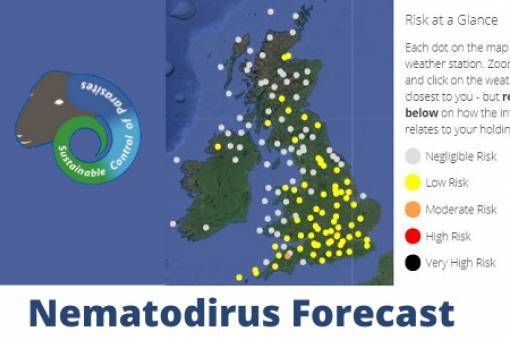
Timing wormer treatments for Nematodirus can be tricky as the eggs of this worm tend to hatch on-mass when environmental conditions are optimal in spring (unlike the eggs of other roundworms which hatch continuously throughout the summer). The mass-hatching of Nematodirus in spring exposes lambs to a lot of worms at once which can cause significant disease. Damage to lambs is mainly caused by the Nematodirus larvae, so faecal egg counts (which only detect the presence of egg-laying adults) are not the recommended diagnostic for young lambs. The SCOPS Nematodirus Forecast is a useful tool which predicts when Nematodirus eggs are likely to hatch throughout the country and when a wormer treatment would likely be useful.
For more information, click here to become a friend of Moredun and access our newssheet!
Barbers’ pole worm (Haemonchus)
Barbers’ pole worm is a blood-feeding roundworm, unlike the other strongyle-type species. It was once associated with issues in ‘tropical’ climates but is now an increasing problem in the UK with warmer and wetter summers.
Like all roundworm species, barbers’ pole worm causes damage to the tissues and reduces an animal’s ability to digest and absorb foodstuffs. In addition, due to being a blood-feeder, it also causes anaemia.
Disease is typically seen in lambs during late summer but can also occur in adult sheep at any time of year.
Barbers’ pole worms produce ~7000-10,000 eggs per day. This means that pastures get contaminated very quickly, and interpreting faecal egg counts is more difficult. Due to this, the current version of FEC Check is not suitable for use on farms that have problems with barbers’ pole worm.
There is currently a vaccine licensed for this roundworm in Australia (BarberVax®) and South Africa (Wirevax),which was developed at Moredun. This is not currently licensed in the UK but can be sought by a vet in certain cases where this worm is causing significant issues.
If you are unsure about whether you have a problem with barbers’ pole worm on your farm please speak to your vet.
For more information, click here to become a friend of Moredun and access our newssheet!